The main missions of the structural subsystem are to:
Provide mechanical and assembly support for all satellite equipment (both payloads and all other subsystems),
Maintain the geometrical and structural integrity of the satellite and its units throughout the service life, in particular during launch and under all specified environmental conditions.
The primary structure of the UPM-Sat 2, designed entirely in aluminium, has a modular configuration, consisting of four parallel trays joined at their corners by bars that form a structural frame. Four flat panels enclose the structure at the sides.
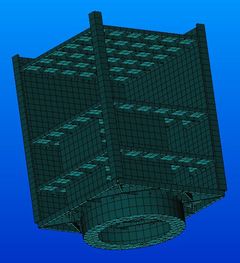
The trays are the main structural element. Most of the satellite’s components and subsystems are installed on them. They have been designed with an orthogrid-type structure, in order to reduce their mass without penalising rigidity.
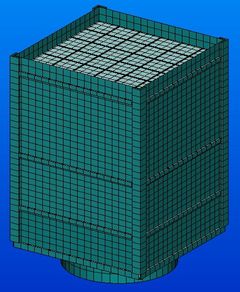
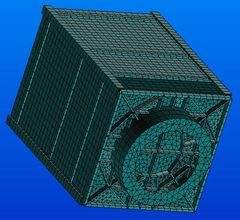
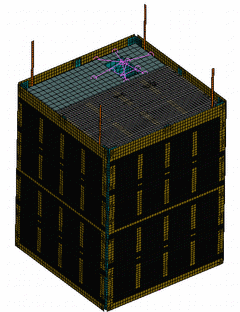
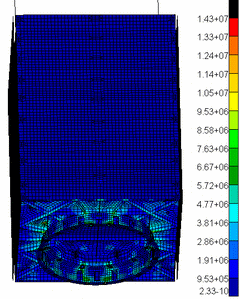
Structural analyses verifying the mechanical behaviour of the satellite under launch loads are performed with the finite element model. It is mainly composed of quadrilateral plane elements and contains approximately 40 000 nodes.
The structural analyses to be carried out are:
Static analysis with inertial acceleration: 5 g in lateral direction and 8.5 g in vertical direction.
Sinusoidal vibration analysis
Random vibration analysis.
Shock analysis.
The results of these analyses will be decisive in the structural verification of UPMSat-2, which will culminate in the performance of the final tests.
Figure 1: FEM model of UPMSat-2 (left) and stress distribution (Pa) due to inertial acceleration of 8.5 g in the vertical direction.