
Power supply and management
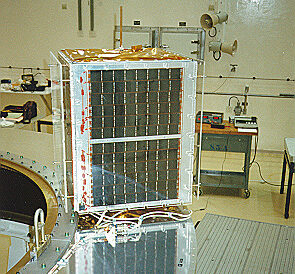
The power is generated by the four solar panels located on the satellite’s side faces. Due to the in-orbit technology demonstrator nature of the UPM-Sat 1 space platform, two of the solar panels are experimental and have been supplied by ESA/ESTEC: one, manufactured by DASA, incorporates silicon cells and a new aluminium interconnector system, and the other is a gallium arsenide cell panel manufactured by FIAR. The other two panels are proven silicon cell technology, manufactured by DASA-WEDEL. The panels are rectangular in shape (425 mm x 530 mm) and are each capable of providing a power output of 30 W at the start of the mission. The total number of cells that make up the four panels is 696 and the average power delivered over one orbit is 20 W.
Two batteries, each consisting of 14 nickel-cadmium cells, GATES model GH 6000F, have been used for energy storage. The two batteries are connected in parallel so that there is equipment redundancy.
Operation during eclipses and excess demand over the capacity of the solar panels is ensured by these batteries, which supply 6 Ah each. This subsystem has the capacity to switch 20 loads with output levels of 5 V, -12 V, -15 V, 24 V and 30 V, and also incorporates voltage level control devices and current limiters and load disconnection in the event of a short circuit, as well as protection and charging control of the batteries and the timing of the latency period after separation.
Battery charging and power distribution is controlled by two electronic boards; one board is responsible for controlling the generation and accumulation of energy, ensuring that safety levels are not exceeded, and the other manages power distribution to on-board equipment.